
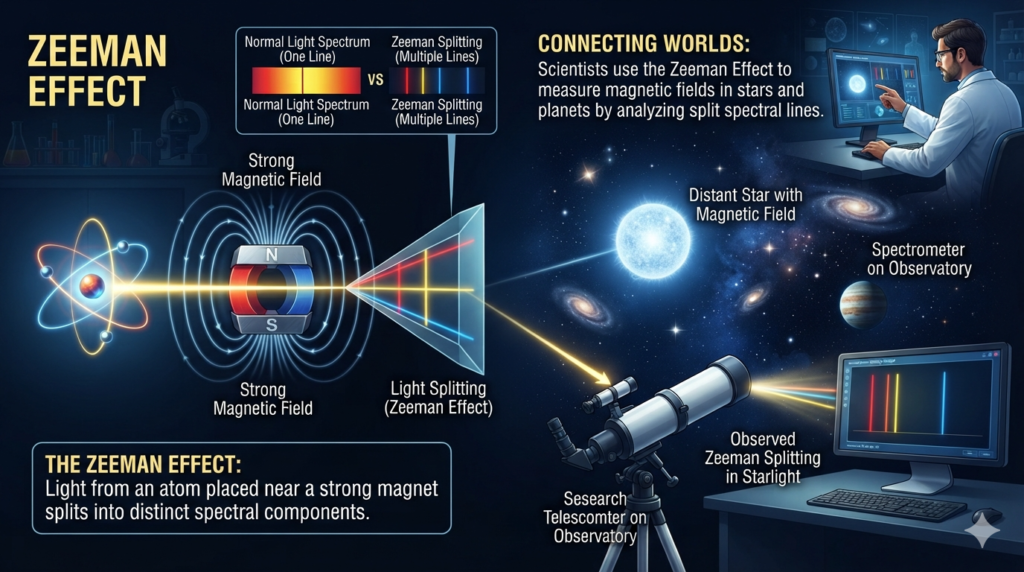

Have you ever wondered how scientists study the tiny world of atoms? One of the most interesting tools they use is the zeeman effect. At its heart, the zeeman effect shows us how nature behaves in unique ways. When an atom is placed near a strong magnet, something amazing happens to its light. The light splits into different parts, almost like a prism creating a rainbow. This simple discovery changed how we understand the universe. By looking at how the zeeman effect changes light, researchers can figure out the magnetic secrets of stars and planets. It is a beautiful example of how physics connects the smallest particles to the giant cosmos above us.
What Exactly Is the Zeeman Effect?
The zeeman effect happens when we place a source of light, like a glowing gas, into a magnetic field. Normally, atoms give off light at specific, set wavelengths. These show up as sharp lines on a chart called a spectrum. However, when a magnetic field is turned on, those sharp lines break apart. This splitting of spectral lines is exactly what we call the zeeman effect. It tells us that the energy levels inside an atom are shifting because of the magnetic force.
Who Was Pieter Zeeman?
The effect is named after Pieter zeeman, a brilliant Dutch physicist. In 1896, he made this famous discovery while working in his lab. His work was so important that he won the Nobel Prize in Physics in 1902. Pieter zeeman helped prove that magnetism affects the motion of electrons inside an atom. Before his work, scientists were still learning about the structure of the atom. By observing how light changed, he gave us a brand-new way to “see” inside the invisible world.
How Do Spectral Lines Split?
To understand the zeeman effect, think of an atom as having tiny energy steps. Usually, electrons jump between these steps and release light. When you add a magnetic field, it forces these energy levels to split into smaller, sub-levels. Because the energy levels change, the light they release also changes slightly. This is why we see the lines split into several parts. This splitting is a clear sign that a magnetic field is nearby and working on the atom.
The Normal vs. Anomalous Zeeman Effect
Scientists often talk about the “normal” and “anomalous” types of the zeeman effect. The normal zeeman effect is the simple version where a line splits into three distinct pieces. However, for many atoms, the lines split into more complex patterns. This is the anomalous zeeman effect. It sounds strange, but it happens because of something called “electron spin.” Once scientists understood that electrons spin like tiny tops, the mystery of the anomalous zeeman effect was finally solved.
Why Is the Zeeman Effect Important?
Why should we care about the zeeman effect? It is incredibly useful in astronomy. Stars have powerful magnetic fields that we cannot measure directly with a ruler. Instead, astronomers look for the zeeman effect in the light coming from these stars. If the light lines are split, they know a magnetic field is present. This helps us map the magnetic activity of the sun and other distant stars. Without the zeeman effect, our understanding of space would be much smaller.
Atoms and Magnetic Fields
Atoms are like tiny magnets themselves because of their moving electrons. When an external magnetic field is applied, it interacts with these tiny atomic magnets. This interaction is the root cause of the zeeman effect. Depending on how the atom is oriented, the energy shift can be different. This is why the zeeman effect is so sensitive. It reacts to even very weak magnetic fields, making it a powerful tool for high-precision scientific measurements in labs around the world.
Learning from Quantum Mechanics
The zeeman effect is a classic topic in quantum mechanics. It helps students learn about quantum numbers and energy states. By studying the zeeman effect, we see how mathematical rules describe the physical world. It shows that energy is “quantized,” meaning it comes in specific packets rather than a smooth flow. This simple concept is the foundation of all modern electronics, from your phone to advanced medical scanners.
Practical Uses in Modern Science
Beyond stars, the zeeman effect is used in medical technology. It relates to the basics of Magnetic Resonance Imaging (MRI). By controlling magnetic fields and observing atomic responses, doctors can look inside the human body without surgery. Even though it started as a pure physics experiment, the zeeman effect now helps save lives every single day. It is a perfect example of how basic research leads to great inventions.
How to Observe the Zeeman Effect
If you were in a university lab, you might see the zeeman effect using a special magnet and a spectroscope. You would place a tube of glowing mercury or neon gas between the magnet’s poles. As you turn the power up, the spectroscope displays the lines changing. Using a polarizer, you can even filter the light to see specific parts of the split lines. It is a hands-on way to watch the laws of nature in action.
The Future of Atomic Research
Scientists continue to study the zeeman effect to explore new materials. By understanding how magnetism changes atomic light, we can create better sensors and faster computers. The zeeman effect remains a hot topic in quantum research. As we find more ways to control atoms, the legacy of Pieter zeeman lives on in every new discovery we make.
Key Details Summary
| Feature | Description |
| Discoverer | Pieter Zeeman (1896) |
| Main Phenomenon | Splitting of spectral lines in magnetic fields |
| Primary Cause | Interaction between magnetic fields and electron angular momentum |
| Key Scientific Field | Atomic Physics / Quantum Mechanics |
| Major Applications | Astronomy (star magnetism), MRI technology, Quantum sensors |
Frequently Asked Questions
1. What is the Zeeman effect in simple terms?
It is the splitting of spectral lines of light when an atom is placed in a magnetic field.
2. Who discovered the Zeeman effect?
It was discovered by the Dutch physicist Pieter Zeeman in 1896.
3. Why do spectral lines split?
They split because the magnetic field changes the energy levels of the electrons inside the atom.
4. What is the difference between normal and anomalous?
The normal effect splits lines into three parts; the anomalous version involves electron spin and creates more complex patterns.
5. How is this used in space science?
Astronomers use the zeeman effect to measure the strength of magnetic fields in stars.
6. Does the Zeeman effect relate to MRIs?
Yes, it is related to the core principles of using magnetic fields to influence atomic energy states for imaging.
Conclusion
The zeeman effect is more than just a physics term; it is a window into the hidden world of atoms. From the brilliant mind of Pieter zeeman to the high-tech MRI machines used today, this discovery has shaped our modern world. Whether you are an astronomy fan or a student of science, understanding the zeeman effect helps you appreciate the invisible forces that govern our universe. Do you have a favorite experiment or a topic in physics you would like to explore next.